Is QJ201 Aluminum Brazing Flux Corrosive?
|
The short answer: QJ201 is a product designation, not a universal formula. Corrosion risk depends on the actual chemistry of the flux and the residue it leaves after brazing. |
“Will the flux residue corrode the aluminum after brazing?”
This is one of the first questions customers ask us when testing QJ201 aluminum brazing flux. It is a reasonable concern, especially when the finished parts are used in refrigeration systems, aluminum pipelines, heat exchangers or other applications where even minor corrosion may eventually cause leakage.
The honest answer is that it depends on the formulation. QJ201 is widely used as a product name in the brazing industry, but products carrying that name do not always share the same chemical composition. Two QJ201 fluxes can therefore behave very differently after brazing.
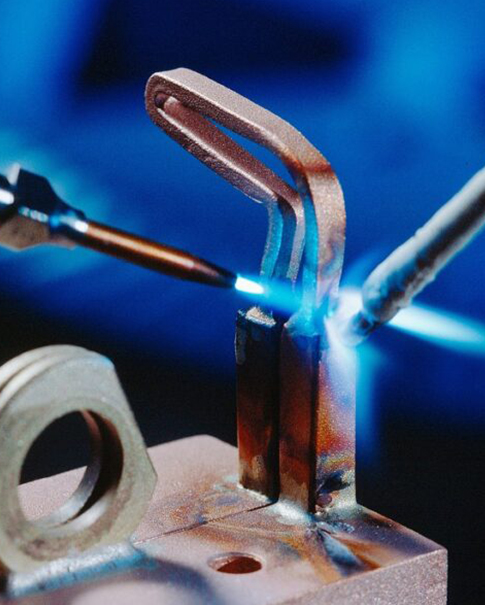
Aluminum is difficult to braze because a thin oxide film forms on its surface almost immediately. This film prevents molten filler metal from wetting the surface and flowing properly into the joint.
QJ201 flux is used to break down that oxide film and protect the joint during heating. The challenge is balance: the flux must be active enough to clean the aluminum, but it should not leave residue that creates problems later.
Traditional aluminum fluxes often contain chloride salts. They can perform very well under the flame, but their residue may absorb moisture. If that residue remains around the joint or becomes trapped inside a narrow gap, corrosion can develop gradually.
A part may look perfectly acceptable when it leaves the production line. Weeks or months later, however, white deposits, pitting, discoloration or leakage may appear—particularly in humid or salt-laden environments. This is why we look beyond how a flux behaves during brazing and pay equal attention to what remains after the joint cools.
Tongling Xinxin Welding Materials Co., Ltd. developed XINXIN QJ201 for the brazing of aluminum and aluminum-alloy components with suitable aluminum-based filler metals.
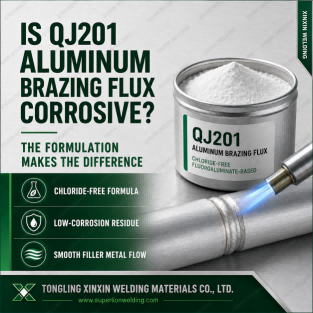
Our QJ201 uses a chloride-free fluoroaluminate-based system. It is designed to remove the oxide layer, improve filler-metal wetting and help the molten alloy move smoothly through the joint. Compared with traditional chloride-containing fluxes, its post-braze residue has low moisture absorption and presents a much lower corrosion risk to aluminum under normal service conditions.
Customers use XINXIN QJ201 in a range of applications, including:
· Aluminum pipe and fitting connections
· Refrigeration and air-conditioning components
· Heat exchangers and cooling assemblies
· Aluminum tanks and containers
· Automotive aluminum parts
· General aluminum fabrication and repair
Flux, filler metal and process must work as a system. The final joint is influenced by the aluminum grade, filler alloy, joint clearance, heating method and operator technique—not by the flux alone.
For a chloride-free fluoroaluminate flux, the residue is generally considered non-corrosive under normal service conditions. In many applications, it does not need to be removed solely for corrosion prevention.
Cleaning may still be required if the component will be painted, plated, electrically connected or inspected to a strict cosmetic standard. Flux should also be applied in a thin, controlled layer. Using more than the joint needs does not improve brazing performance; it simply leaves more residue and makes the finished part harder to clean.
If you are using a QJ201 product from an unfamiliar source, check its SDS and technical data rather than relying on the name printed on the package. When chloride salts are present, the residue normally needs to be removed thoroughly after brazing.
We sometimes receive customer samples where the flux is assumed to be the cause of poor flow or a weak-looking joint. During testing, we often find another reason: excessive heat, the wrong brazing alloy, too much flux, an unsuitable joint gap, or oil and heavy oxide remaining on the aluminum surface.
A few practical details make a noticeable difference:
· Apply a thin, even layer of flux around the joint.
· Heat the assembly gradually instead of concentrating the flame on one point.
· Let the heat of the workpiece melt the filler metal.
· Stop and review the heating method if the flux turns dark before the alloy flows.
· Remove oil, moisture and heavy surface contamination before brazing.
When flux burns before the filler metal begins to flow, it loses activity and can no longer protect the joint effectively. Adding more flux rarely solves that problem; controlling the heat usually does.
The term QJ201 alone cannot tell a buyer whether an aluminum flux is corrosive. A traditional chloride-containing formulation may leave hygroscopic residue that requires thorough cleaning. A properly formulated chloride-free fluoroaluminate flux leaves a more stable residue and is better suited to components where long-term corrosion resistance matters.
Before approving any flux for production—especially for refrigeration systems or pressure-containing parts—we recommend testing it with the actual base material, filler alloy, joint design and heating process.
Tongling Xinxin Welding Materials Co., Ltd. has specialized in brazing and welding materials for more than 15 years. Alongside QJ201 aluminum brazing flux, we manufacture aluminum brazing alloys, aluminum and copper-aluminum flux-cored rods, silver brazing alloys, copper-phosphorus alloys and brass brazing rods.
Our work does not stop at supplying material. We help customers match the flux with the correct filler alloy, review brazing parameters and test samples before bulk production.
If your aluminum joint is not flowing, filling or holding as expected, send us the base-material grade, filler alloy, heating method and a clear photo of the joint. Our team will help you review the process.
Tongling Xinxin Welding Materials Co., Ltd.
Brazing Materials Manufacturer in China
Website: https://www.superlionwelding.com/
Tel : +86 13705623213
Email : Jasmine@xxhccn.com
Wechat : +8613705623213
Whatsapp : +8613705623213
Address : 4077 Qifeng Road, Tongling, Anhui, China