Meta Description
Brazing joint cracks can lead to leakage, reduced strength, costly rework, and product failure. Discover the most
common causes of brazing joint cracking, practical prevention methods, and expert brazing solutions from XINXIN
WELDING.
Every Brazing Crack Tells a Story
A cracked brazed joint is more than just a manufacturing defect—it is often a sign that something in the brazing
process has gone wrong.
Whether you’re producing HVAC heat exchangers, refrigeration systems, automotive components, electrical
connectors, power equipment, or industrial machinery, brazing cracks can result in leakage, reduced mechanical strength,
costly repairs, and even complete product failure.
Many manufacturers initially suspect poor filler metal quality. However, in reality, most brazing cracks are caused
by a combination of factors, including material compatibility, filler metal selection, brazing parameters, joint design,
surface preparation, and residual stress.
Understanding these factors is the key to producing stronger, safer, and longer-lasting brazed joints.
1. Material Compatibility – The First Step Toward Reliable Brazing
Material compatibility is one of the most important factors affecting brazing quality.
Different metals expand and contract at different rates during heating and cooling. When the coefficient of thermal
expansion (CTE) differs significantly between the base material and the filler metal, high thermal stresses develop during
cooling.
Typical examples include:
▶ Copper to aluminum
▶ Stainless steel to copper alloys
▶ Cemented carbide to steel
▶ Ceramic-to-metal assemblies
If the filler metal is not properly matched to the application, these thermal stresses can easily initiate cracks.
Another common issue is the formation of brittle intermetallic compounds (IMCs). Excessive diffusion between the
filler metal and the base material during brazing produces hard, brittle layers that reduce ductility and increase the likelihood
of cracking.
Some base materials—including high-carbon steel, tool steel, titanium alloys, and cemented carbide—are naturally
more susceptible to thermal stress and often require carefully controlled cooling procedures.
Likewise, brazing alloys containing relatively high levels of phosphorus, silicon, or boron generally have lower ductility
and may be more prone to cold cracking under severe loading conditions.
2. Improper Brazing Parameters
Even when suitable materials are selected, poor process control can still lead to joint failure.
Excessive Brazing Temperature
Higher temperatures do not necessarily produce stronger joints.
Overheating may:
▶ Accelerate base metal erosion
▶ Promote excessive diffusion
▶ Increase brittle intermetallic compound formation
▶ Generate higher residual stress
Excessive Holding Time
Keeping the assembly at brazing temperature for too long allows brittle phases to continue growing, reducing
joint toughness.
Rapid Heating or Cooling
Rapid heating creates uneven temperature distribution, while forced cooling by air or water generates severe thermal
stress.
This is particularly critical when brazing cemented carbide, high-strength steel, and titanium alloys.
Non-Uniform Heating
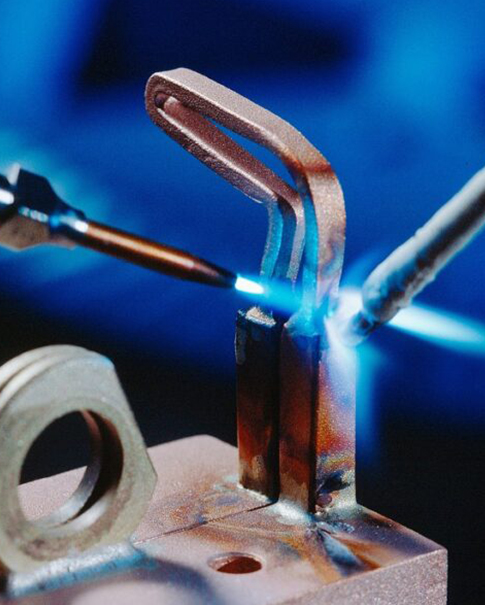
Localized overheating during flame brazing often causes uneven filler metal flow, incomplete wetting, and stress
concentration, all of which increase the risk of cracking.
3. Joint Design and Residual Stress
Joint geometry is just as important as material selection.
Improper joint clearance can significantly reduce joint performance.
▶ Clearance that is too large produces a thick filler layer that experiences greater shrinkage during solidification.
▶ Clearance that is too small restricts capillary action and may leave voids or incomplete bonding.
Other common sources of stress concentration include:
▶ Sharp corners
▶ Sudden changes in section thickness
▶ Rigid assemblies
▶ Excessive clamping force
▶ Highly constrained structures
Good joint design allows thermal stress to be distributed evenly throughout the assembly.
4. Surface Preparation and Joint Defects
Clean surfaces are essential for successful brazing.
Oil, grease, oxide films, and contamination reduce wettability and frequently result in:
▶ Lack of bonding
▶ Porosity
▶ Slag inclusions
▶ Incomplete filling
Each of these defects can become the starting point for crack propagation.
Flux selection is equally important.
Using an unsuitable brazing flux—or failing to remove corrosive flux residues after brazing—may cause long-term
corrosion that weakens the joint during service.
5. Residual Stress and Service Conditions
Some brazed joints crack immediately after cooling.
Others may not fail until weeks or even months later.
Delayed cracking is often caused by:
▶ Residual thermal stress
▶ Lack of stress-relief heat treatment
▶ Rapid cooling
▶ Thermal cycling
▶ Mechanical vibration
▶ Cyclic loading
▶ Hydrogen embrittlement
Although microscopic at first, these cracks gradually propagate until the joint eventually fails.
Common Types of Brazing Cracks
| Crack Type | Typical Causes |
| Hot Cracking | Excessive brazing temperature, prolonged holding time, impurity segregation |
| Cold Cracking | Rapid cooling, thermal expansion mismatch, brittle filler metal, residual stress |
| Intergranular Cracking | Grain boundary penetration and excessive intermetallic compound growth |
| Fatigue Cracking | Repeated thermal cycling and mechanical loading |
| Crack Growth from Porosity | Poor cleaning, improper joint clearance, incomplete filler penetration |
Practical Solutions to Prevent Brazing Joint Cracking
Although brazing cracks may appear complex, most can be prevented through proper engineering practices.
Recommended actions include:
▶ Select compatible base materials and brazing filler metals.
▶ Choose the correct brazing flux for the application.
▶ Optimize brazing temperature and holding time.
▶ Maintain proper joint clearance.
▶ Thoroughly clean all joining surfaces before brazing.
▶ Apply uniform heating and controlled cooling.
▶ Reduce residual stress through improved joint design.
▶ Inspect joints carefully for porosity, inclusions, and incomplete filling before production.
Preventing cracks is always more cost-effective than repairing failed assemblies.
Case Study: Solving Brazing Cracks in Copper-to-Aluminum Heat Exchangers
One manufacturer of refrigeration heat exchangers experienced recurring cracks after brazing copper tubes to
aluminum headers.
Although the filler metal met industry standards, analysis showed that excessive thermal stress and poor process
control were the primary causes of failure.
After optimizing the filler metal selection, improving flux compatibility, adjusting joint clearance, and refining the
heating profile, the manufacturer achieved a significant reduction in cracking while improving production consistency
and reducing overall manufacturing costs.
This example highlights an important principle:
Successful brazing depends on the complete brazing system—not simply on changing the filler metal.
How XINXIN WELDING Can Help
At XINXIN WELDING, we understand that every brazing application is unique.
For more than 15 years, we have supported customers around the world with not only high-quality brazing materials,
but also practical engineering expertise.
Our technical team helps customers improve brazing quality by providing:
▶ Selection of the most suitable brazing filler metals
▶ Professional brazing flux recommendations
▶ Process optimization for flame, induction, and furnace brazing
▶ Joint design and clearance recommendations
▶ Failure analysis for cracked joints, porosity, poor wetting, incomplete filling, and weak bonding
▶ Customized brazing solutions for HVAC, refrigeration, automotive, electrical equipment, energy storage, power
transmission, and industrial manufacturing
Whether your challenge involves joint cracking, leakage, porosity, inconsistent brazing quality, or low joint
strength, our engineers are ready to analyze the root cause and recommend a practical, cost-effective solution.
We don’t just manufacture brazing materials—we help our customers achieve reliable, high-performance
brazed joints.
Why Choose XINXIN WELDING?
▶ More than 15 years of manufacturing experience
▶ ISO 9001 certified quality management system
▶ CE, RoHS, and REACH compliant products
▶ OEM and customized brazing solutions
▶ Stable global supply capability
▶ Professional technical support before and after sales
▶ Fast response for brazing process troubleshooting
Contact XINXIN WELDING
If you’re experiencing brazing cracks, leakage, porosity, weak joints, or any other brazing challenges, our engineering
team is here to help.
Simply tell us:
▶ Your base materials
▶ The brazing filler metal currently in use
▶ The flux you are using
▶ Your heating method (Torch, Induction, Furnace, etc.)
▶ Photos of the failed joint (if available)
We’ll work with you to identify the root cause and recommend the most effective brazing solution.
XINXIN WELDING — Your Trusted Partner for Professional Brazing Solutions.
Tel : +86 13705623213
Email : Jasmine@xxhccn.com
Wechat : +8613705623213
Whatsapp : +8613705623213
Address : 4077 Qifeng Road, Tongling, Anhui, China